
The In-Between Places.


“Often called ‘zen gardens’, they are comprised of very few elements spaced out over a large distance. Often just a small mound of moss or stone, surrounded by a sea of gravel, these gardens are built on the principle of ‘yohaku no bi’ or the beauty of white space. Graphic designers have used this principle for years, spending just as much time looking at the space between the words, paragraphs, images or pictures they’re designing with as they do on the thing themselves”.Excerpt From Good Services: How to Design Services that Work.
The Japanese have hacked the act of mindful living. Their culture is rich with words with deep, elegant meaning—often expressing philosophies for living with intention, beauty, and presence. Here are a few to buttress my point before I proceed:
Ikigai— “Reason for being”. Which is about finding the intersection of what you love, what you’re good at, what the world needs, and what you can be paid for. Living with purpose and alignment.
Wabi-sabi — “Beauty in imperfection and impermanence”. The act of appreciating the cracked, the worn, the weathered parts of our lives. Finding beauty in the imperfections and letting it form the full tapestry of our lives. Embracing transience and flaws as part of life’s poetry.
Oubaitori — “Cherry, plum, peach, and apricot”. These four trees blossom in their own time, each with its unique beauty. Meaning we shouldn’t compare our journeys. We should allow ourselves to bloom in our season.
Danshari— “Declutter to free the spirit”. Letting go of what no longer serves you—physically, mentally, emotionally. Simplicity creates space for clarity.
Yūgen— “A profound, mysterious sense of beauty in the universe”. This teaches us that not all beauty is visible. Some truths are felt, not seen. To live with awe and quiet wonder.
Gaman — “Quiet endurance, dignity under pressure”. Hold your ground with grace. Strength can be calm, silent, and internal. Staying grounded in discomfort, without losing yourself.
And there there is Ma— “The space between” is closely in meaning to ‘yohaku no bi, the “topic du jour”. It says meaning doesn’t just live in the things—it lives in the space between them: in the silences, the pauses, the empty spaces. It says we let life breathe. Don’t rush to fill every space.
What do we do with the in-between spaces in our lives? They are sometimes forced pauses, like when we are in between jobs, recovering from an illness, or out of a relationship.
"In-between places," also known as liminal spaces, a term borrowed from anthropology, is a state of transition where one is on the threshold of a new phase. The space where old ways of being are dissolving, but new ones haven't fully taken shape.
This space can be both challenging and full of potential; it’s transitional, full of uncertainty and discomfort, but also a time of great opportunity for growth, self-discovery, and transformation.
Our lives are in a constant state of flux with ebbs and flows; therefore, learning to navigate these in-between spaces is crucial for personal development.
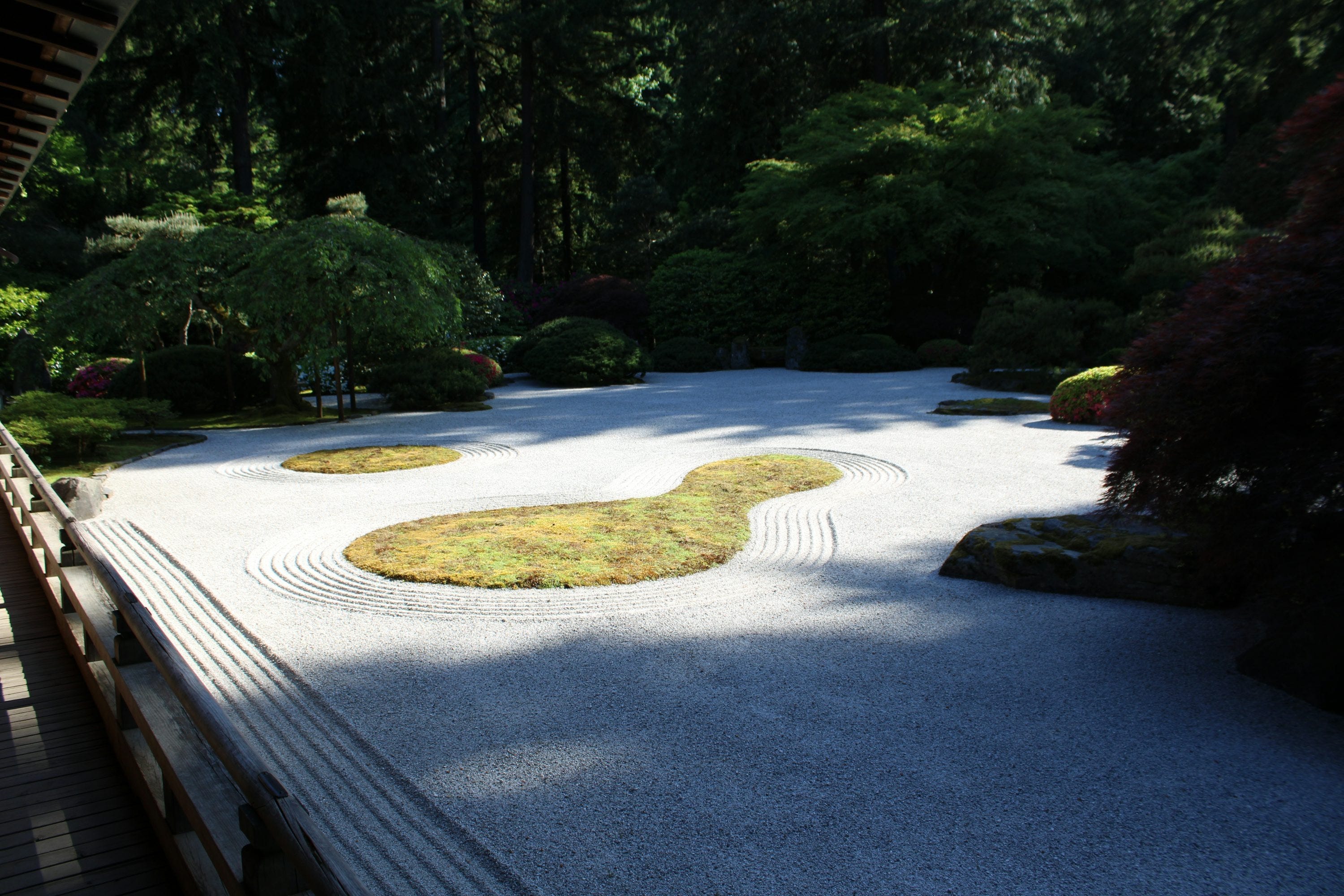
Here’s what the Japanese know about ‘Yohaku no bi’ and Zen gardens that we should, too:
• Elegance in Restraint: Beauty doesn’t come from filling every space, but from what’s intentionally left empty. This invites the viewer’s imagination and emotional response.
• Room to Breathe: In Zen gardens, the empty gravel areas (yohaku) provide visual and mental “breathing space.” They allow the eye and mind to rest, encouraging introspection.
• Invitation to Interpretation: The white space isn’t void or lacking—it’s potential. It asks the observer to engage, to bring themselves into the space, and to find personal meaning in the minimal.
• In a Zen garden, a single rock in a sea of raked gravel becomes powerful not because it is adorned, but because it is surrounded by intentional emptiness.
• The absence of colour, flowers, or clutter directs the focus inward—toward stillness, form, shadow, and thought.
Zen gardens and the principle of ‘yohaku no bi’ embody some sort of spiritual design— a yin-yang that reminds us that silence can be louder than noise, that absence can be full, and that simplicity can lead to the most profound insight.
I told the “babe GPT” to write a poetic metaphor for ‘Yohaku no bi’, and she came back with this. It’s perfect.
Yohaku no Bi: The Whisper Between the Words:
“Yohaku no bi” is the hush in a sentence,
the pause before the music,
the light between leaves in the afternoon.
It is the breath the canvas takes before the first stroke.
The margin that makes the story legible.
The room that lets beauty exhale.
We often think space is a void—
But in truth, it is presence, unspoken.
It’s not what’s missing,
It’s what is made possible.
Like the quiet pause before “I love you,”
the space after grief where healing begins,
the white of the page that gives words their weight—
Yohaku no bi is where meaning lives.
To live with it is to resist the urge to fill.
To let silence say something.
To know that what is left unsaid
still holds power.
Keep going,
Ije
This piece was “Yohaku no bi” in action.
The simplicity of the words. The fluidity of ideas. Amazing.
“Yohaku no bi” is such a surreal concept. I also understood it to mean that there’s a lot of beauty in the mundane; the ordinary, even as we tend to chase extraordinary lives.
Thank you for sharing!
Looking forward to more.