
Life Math.


Years ago, when I was learning about financial statements, for some reason, the balance sheet was the one that took me a while to grasp. The whole ‘both sides always balances’ gave me a bit of a headache.
The balance sheet is quite telling in the accounting/financial world, where it’s native, and also in a broader sense.
It’s a statement that provides a “snapshot” of a company’s financial position at a specific point in time. It shows what a business owns (assets), owes (liabilities), and the amount invested by owners (equity).
The equation is Assets = Liabilities + Equity
Assets are tangible things that have economic value: cash in the bank, cars, buildings, laptops, etc.
Liabilities are what are owed to other people, like loans and rent that haven’t been paid, money yet to be paid to vendors, etc.
Equity is really yours (the owners of the company, its shareholders), the money you put into the business, and the profit you made after you remove or have paid all your debt.
A balance sheet by name and nature means that if assets are 1000, then liabilities and equity together must be 1000. Always!! Always!!
I struggled with the math of it for a while till I thought about it this way: everything we have was gotten either by buying it outright or by borrowing, or a combination of the two.
We can have things, and they are not all ours. Take a 100 million dollar house, for example. It’s an asset, it’s yours, and you live in it. But let’s say your down payment for it before you moved in was $30m; it means what you really own, i.e., your equity, is $30m, and your mortgage/loan, aka liabilities, is $70m.
In the balance sheet terms of assets = liabilities + equity, yours is 100 = 70 + 30.
The more you pay your down payments, the more your liabilities reduce, and the larger portion of the house that is ‘bonafidely’ yours increases (not in the eyes of the world, because so many people are so highly leveraged that nothing they have is really theirs, but between your conscience and what you know is true and your bankers, you have truly become yours), and vice versa.
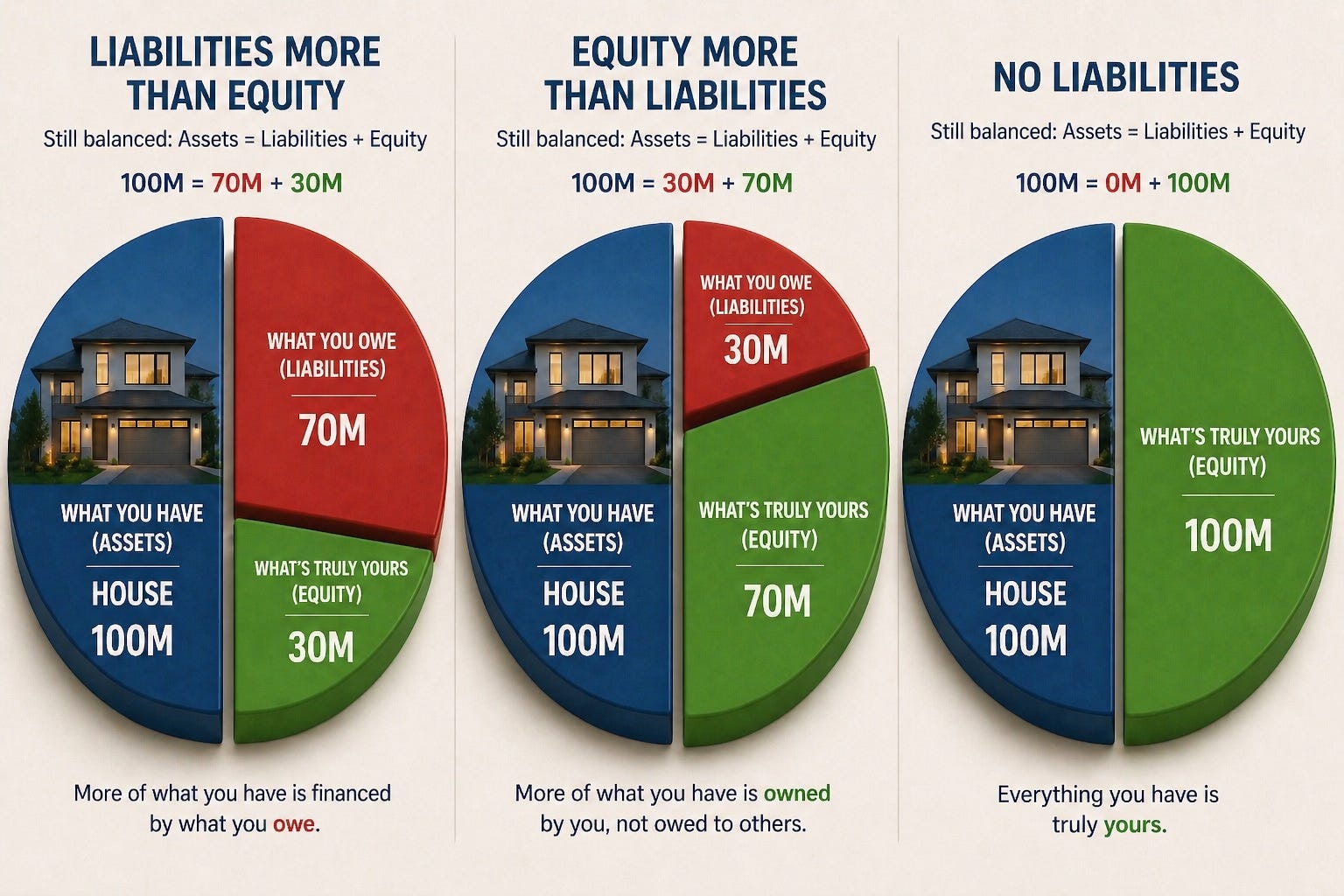
But no matter what happens, even if the value of the house or assets reduces, which happens, the current value will always equal the liabilities and equity.
Essentially, everything you have is gotten by either debt, your own money, or a combination of both.
Why have I decided to teach accounting? Remember when I said the balance sheet is telling in a broader sense earlier? It’s because our lives are walking, talking balance sheets in principle.
Our assets are all the things we have in a tangible way that have some form of value, skills, knowledge, health, experiences, relationships, reputation, character, network, etc.
Liabilities are the things that take away from you, bad habits, toxic relationships or wrong associations, unresolved emotional and mental issues,
You kind of know the drill now; equity is who you really are. When you remove the version of yourself that people see, the accomplishments, the fancy education, and the high-hitting friends. Subtract your liabilities, and what is left is what is truly yours.
Think of it as the things that would stay if you lost everything, lost all your skills and had amnesia or arrived in a new country where no one knew you. What would you use to build? That is your equity.
In life, equity isn’t our titles, income, or reputation. It’s who we actually are at our core. It is the version that would remain if we stripped away the borrowed identities, the performative achievements, and the things you own that were funded by debt (financial, emotional, etc.).
A person can look extraordinarily impressive on the outside and carry so much liability that their true equity is thin. And vice versa.
Equity is substance.
Much like in business, all the things we have and attained were funded by either our liabilities or our equity in different proportions.
It always balances out. We can increase our assets, for example, by working really hard to build a business or gain a skill; that process could be funded by punishing your body, late nights, dubious ethics, destroying relationships, all liabilities, and not enough equity other than tenacity. Do the reverse.
I know I’m painting a more extreme picture, but I hope you get the gist.
The great thing about a balance sheet is that it isn’t a damning tool; it’s an in-the-moment snapshot for information purposes. Come next month, it could look completely different.
So a regular audit can help us start moving more in the direction we would like to build more equity in.
Most of us would do a rough “balance-sheeting” at the beginning of every year. But we tend to focus on asset and liability-type things and less on equity.
Life math class is over.
Keep going,
Ije
I have a degree in math and I learned more about Balance sheet from this than I did in school. Thanks for writing this. And tying it back to life was so smooth. Cheers to more equity. 🥂